There is a number that appears in almost every Irish document about wound care. It turns up in clinical guidelines, in trade journalism, in conference slides and in pitch decks. Wound care costs the Irish health service €629 million a year.
The Health Service Executive makes the same point in a form that sticks better. Chronic wounds, it says, account for around one euro in every twenty spent on public health in Ireland.
One euro in twenty. It is the kind of statistic that catches you off guard.
It is also, on inspection, a statistic about 2013. It was published in 2019. And the assumptions underneath it were not gathered in Ireland at all.
None of that makes it wrong. In fact, it is the best national estimate available: it comes from a peer-reviewed study, and its authors were scrupulous about its limits. But a figure this load-bearing deserves to be understood rather than repeated, and what is underneath it turns out to be more interesting than the figure itself.
What the number is made of
The estimate comes from Paddy Gillespie, Laura Carter, Caroline McIntosh and Georgina Gethin, published in the Journal of Wound Care in June 2019.
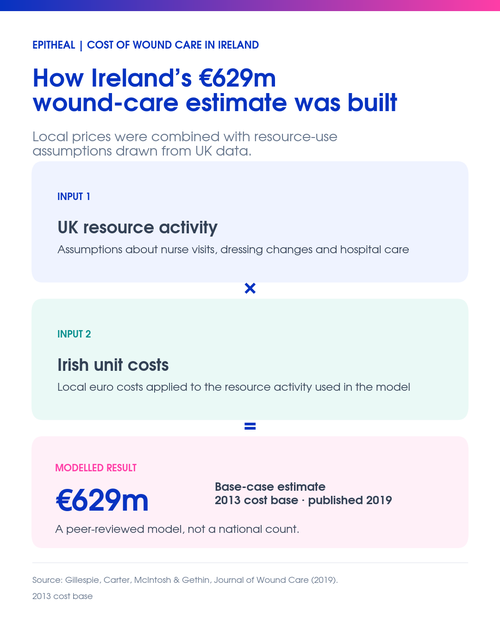
Their method was a bottom-up, prevalence-based analysis built on a decision analytic model. To make it work they needed two things: how much care a wound consumes, and what that care costs in Ireland. The second they had. Irish unit cost data existed. The first they did not, so they took resource activity from a recently published UK study and priced it in euro.
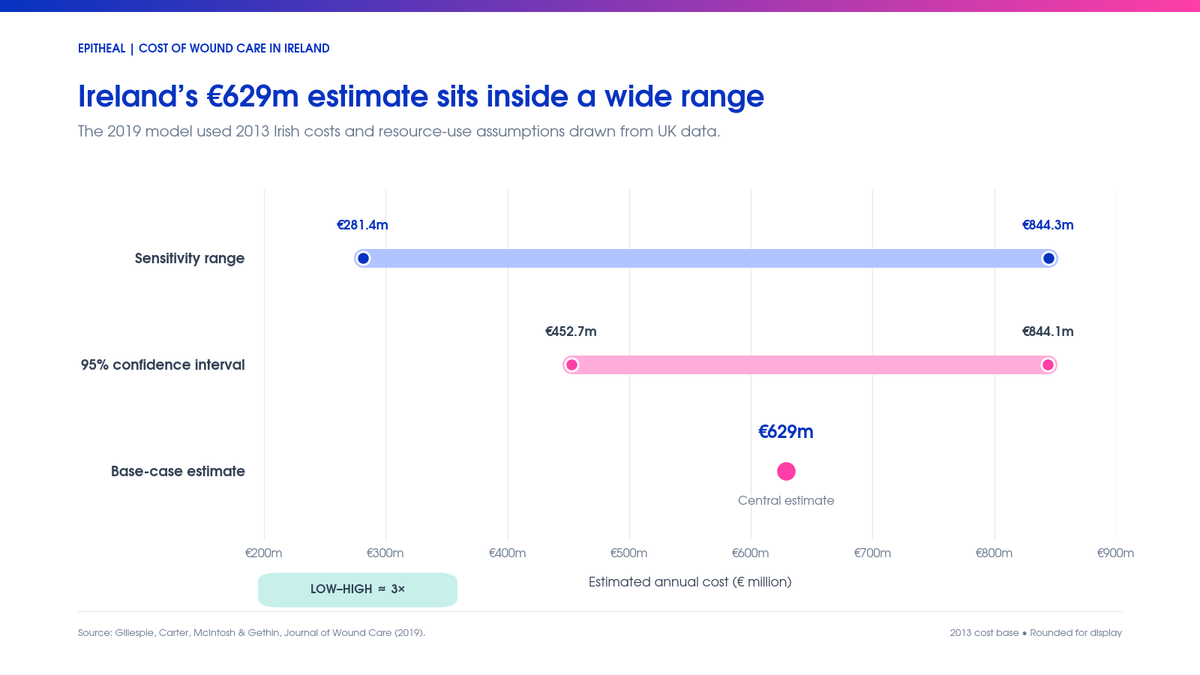
The base case came out at €629,064,198, inside a 95% confidence interval running from €452,673,358 to €844,087,124. That was 5% of total public health expenditure in Ireland in 2013, with a confidence interval of 3% to 6%. Average cost per patient was €3,941, between €2,836 and €5,287.
Then comes the passage nobody talks much about. When the authors varied the model's inputs within plausible bounds, the total ranged from €281,438,970 to €844,316,912.
A threefold spread.
So the accurate version of Ireland's wound care bill is this: somewhere between roughly €280 million and €845 million a year, centred on €629 million, on a 2013 base. Anyone offering €629 million as a current figure is claiming a precision the study never had. The percentage is the more durable statistic, because a share of expenditure does not go stale the way a euro total does.
Three figures, along with a forth that adds perspective
Read around the subject and you will meet three numbers. They appear to contradict each other. Mostly they are measuring different things, and one of them does not survive contact with its own source.
€629 million is the 2019 study. Solid, checkable, anchored to 2013.
€285.5 million is the figure you will find in the HSE's own National Wound Management Guidelines, credited to McDermott-Scales, Cowman and Gethin in 2009. Follow the citation and something is off. That paper is a multi-site census point prevalence survey, and a good one: a 97.2% response rate, a crude wound prevalence of 15.6% across the nursing disciplines surveyed, drawn from 290 wounds in a census of 1,854, and 0.2% across a community population of 133,562. What it is not is a costing study. The €285.5 million figure appears in the literature as an extrapolation, and it covers three chronic wound types rather than wound care as a whole. I could not locate its primary derivation. By rights, it should only ever be cited as a narrow extrapolation.
Roughly €789 million circulates in Irish clinical and trade publications as a current annual cost to the HSE. There is no traceable derivation for it that I could find. It is not an unreasonable number. Irish health spending has grown considerably since 2013, and a constant 5% share would now imply something substantially larger than €629 million. But plausible is not the same as sourced. Until someone produces the working, it should not be presented as an independent estimate.
A fourth figure, for completeness: in 2005, Gethin and colleagues put the cost of managing pressure ulcers alone at around €250 million a year across all Irish care settings.
The data and the research is solid. It is what a field looks like when it has several partial studies, different scopes and different base years.
The UK Factor
Return to how the 2019 estimate was built, because this is where the real vulnerability sits.
The Irish costs were correct. The resource use was borrowed. Every euro in that estimate rests on a British assumption about how many nurse visits a wound generates, how often a dressing gets changed, how much hospital care follows.
In 2022, that class of assumption came under scrutiny at home.
Sean Urwin, Jo Dumville, Matt Sutton and Nicky Cullum published a cost-of-illness study in BMJ Open examining what it costs to treat venous leg ulcers. They used cross-sectional survey data from nine NHS community locales in the north west of England, gathered over two-week periods in 2015 and 2016, and added primary and secondary care resource use from the VenUS IV trial. Then they extrapolated to the UK.
Their numbers came in far below the established ones. For people whose venous leg ulcer was their most severe wound, they put the national annual cost at £95.11 million. They calculated that as 15.9% of the £596.55 million lower bound in the widely cited prior work. Their per-person annual cost of £4,787.70 was 62.6% of the £7,615.03 in the comparator study.
Their point prevalence, notably, matched the existing literature. It was the costs and the annual prevalence that did not. Leg ulcer care is expensive, they concluded, but it may not be as expensive as has been claimed in previous highly cited and influential work.
Two caveats travel with that, and the authors state both. This is one wound type, not the category. And the national extrapolation assumes nine north-west locales stand in for the UK. One study settles nothing.
What it does is puncture an assumption almost everyone in this field carries without examining. Wound care costs are discussed as though revision only ever travels upward: ageing populations, rising diabetes, therefore bigger numbers. Methodologically, that is not how it works. Better data can move a figure down as easily as up.
And the stakes are not academic. The authors point out that the estimates they were testing had already contributed to the development of a national wound care strategy. Numbers of this kind do not sit in journals. They shape policy, and then the policy outlives the scrutiny.
For anyone building a commercial case on the burden of this category, that is the diligence point. The direction of the demographic pressure is well evidenced. The precision of the cost figures is not.
What Ireland does not know
The HSE has said the quiet part out loud. In the June 2025 project report of its National Improvement Programme for Wound Management, the position is stated without hedging: in the absence of a national wound registry, little is known about the true burden of chronic or non-healing wounds in Ireland.
That is not a reporting failure. It is missing instrumentation. Without a registry there is no dependable denominator, no incidence trend, no case-mix, and no way to test a modelled estimate against reality.
The same report notes what comparable jurisdictions have built. Australia and England have national wound care strategies. Ireland has guidelines, from 2018, and now a set of national clinical resources. It does not have a strategy — and the development of a national wound care policy, and of national wound care standards, sat explicitly outside the first phase of the programme's remit.
The gap is not unique to Ireland. The English study above ends on the same note, observing that the ability to estimate costs, examine quality of care and connect care to outcomes is hampered by the lack of routinely collected, useable information in community services, and that the absence of a clinical database for community wound care obstructs even basic clinical communication and monitoring. Wound care is not an unusually opaque field. It is an unusually unmeasured one.
What Irish evidence exists is regional and hard-won. A wound prevalence survey in a mid-west integrated care organisation, reported by Meagher and colleagues in 2021, found that among 1,164 wounds recorded in a cohort of 791 people, leg ulcers were the most common at 46% — consistent with international findings that lower limb ulcers lead, with pressure ulcers second. In 2025, Louise Skerritt, Martin Gooney and Linda Sheahan published a retrospective chart review in the Journal of Wound Care, working through a Public Health Nursing Service caseload across a full year to examine prevalence, aetiology, how care was delivered, how wounds were documented and where patients were referred. Institutional summaries of that research describe wound care fragmented across Irish community settings, and antimicrobials overused as a consequence.
Good studies, all of them. None of them a national picture, and none intended as one.
The document worth watching
The improvement programme was established in 2023 inside the HSE's National Quality and Patient Safety function, co-sponsored by the Office of the Nursing and Midwifery Services Director, with Gillian O'Brien, a Registered Advanced Nurse Practitioner in Tissue Viability and Dermatology at Naas General Hospital, as clinical lead. Phase 1 ran to 2025. Phase 2 is scheduled for 2025 to 2027 and is under way.
Phase 1 produced things clinicians can use tomorrow, free. Two clinical priority areas were chosen: pressure ulcers and lower limb ulcers. Out of that came a Pressure Ulcers Clinical Resource Pack, a Lower Limb Ulcers Clinical Resource Pack, the HSE Pressure Ulcer Staging Tool 2024, and an expansion of the long-established five-step SSKIN care bundle into a seven-step aSSKINg version, adding assess risk and giving information. There are patient and carer leaflets. The packs were co-designed with clinical experts, patient partners and national professional bodies, piloted across 18 services, and endorsed: the pressure ulcer pack by the Tissue Viability Nurses Association of Ireland, the lower limb pack by the TVNAI and the Irish Vascular Society.
But the item with the longest reach is the one least likely to make the news.
Phase 1 also produced a scoping document setting out the rationale for a National Chronic Wound Care Registry, intended for submission to the HSE National Centre for Clinical Audit and written to inform planning and funding. It was signed off at the oversight group's final meeting on 5 June 2025 and submitted to the project sponsors the following day.
A proposal under consideration is not a registry. It is a long way from one, and proposals of this kind die quietly all the time. But it is the mechanism by which Ireland would stop estimating and start counting. If it proceeds, every figure in this article becomes checkable within a few years, including the ones that currently cannot be traced at all.
That matters more than the size of any single number.
What to do with this
If you are assessing the market. Treat every national burden figure as a modelled estimate and ask three questions of it: which study, which base year, which method. If the answer involves resource use imported from another health system, that is a material assumption, not a footnote. Do not accept €629 million without its 2013 base year attached. Treat €789 million as unsourced until someone shows the working. Treat €285.5 million as an extrapolation across three wound types. The real question in Irish wound care is not how big the number is. It is whether the country has any means of knowing, and today it does not. Watch Phase 2, and watch the registry proposal.
If you are behind a counter. The Phase 1 resources are national, current and free: the two resource packs, the Pressure Ulcer Staging Tool 2024, the aSSKINg infographic, and the patient and carer leaflets. For lower limb presentations, the Lower Limb Ulcers pack and the 2018 national guidelines are the reference points, and the leaflets are usable as they are. The weakness Irish community research keeps finding is documentation and referral, and that is the part most within reach of a first point of contact. An assessment that leaves a record behind is what makes a referral work.
For everyone. Consider what a registry would actually answer. Not only what wound care costs, but which wounds are prevalent, where they are being treated, how long they take to close, and which interventions are associated with closure. Ireland cannot answer any of those nationally today.
That absence, not the €629 million, is the finding.
Epitheal is a pharmacist-founded skin and wound recovery company based in Co. Galway. Irish healthcare, and community pharmacy in particular, is a sector we care about. We write about the evidence environment in wound care because it is the one our products have to stand up in.