Key points
- South Australia's Acute Minor Wound Management Clinical Practice Guideline authorises community pharmacists to administer local anaesthetic, cleanse and debride, close wounds and prescribe antibiotics in defined circumstances.
- That guideline excludes topical antibiotics from the service entirely, stating that they do not improve healing potential and may contribute to antimicrobial resistance.
- NHS England announced on 10 September 2026 that five conditions will be added to Pharmacy First, taking the total to twelve. None is a wound.
- Ireland's Common Conditions Service covers eight conditions and does not include a wound. The Department of Health reported that 1,802 of the country's 1,912 community pharmacies had signed up by January 2026.
- The HSE's National Improvement Programme for Wound Management placed general wound management, the diabetic foot, palliative care and surgical site wounds outside the scope of its first phase.
- The 2023 IWGDF classification guideline states that the SINBAD system requires no specialist equipment beyond clinical examination.
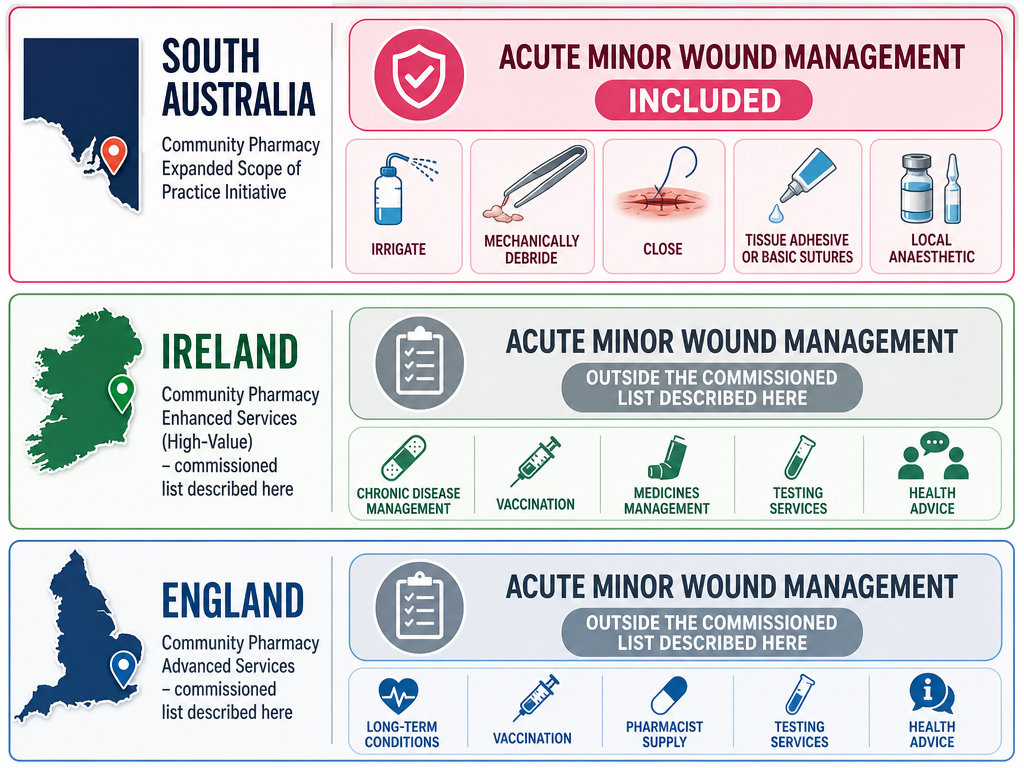
Expanded scope in several Australian states now covers acute minor wound management, with South Australia publishing an eighteen-page clinical guideline. Ireland commissioned eight conditions and England reaches twelve this autumn, with a wound in neither.
South Australia's Acute Minor Wound Management Clinical Practice Guideline is specific to the point of bluntness. It tells the pharmacist which burns require an ambulance and which can go to an emergency department by car. It names the injuries that must not be treated at a counter under any circumstances: suspected tendon, joint, bone or nerve involvement, partial amputation of a digit, a penetrating wound through footwear. It sets a twenty-four hour referral threshold for a skin tear, for an unclear wound history, and for any wound more than four days old that has not begun to epithelialise. It authorises the pharmacist to inject up to ten millilitres of one per cent lidocaine, to irrigate and mechanically debride, to close the wound with tissue adhesive or basic sutures, and to prescribe antibiotics in four narrowly defined situations [1].
Ireland's equivalent document is a list. Allergic rhinitis, cold sores, conjunctivitis, impetigo, oral thrush, shingles, cystitis, vaginal thrush [2]. Eight conditions a pharmacist may now prescribe for, published seven months before the Australian guideline and running to a single page of the regulations that created it. There is no wound on the list, and nothing resembling one.
The gap between those two documents is the subject of this article.
England has just widened the list again, and a wound is still not on it
On 10 September 2026, NHS England announced that five conditions will be added to the Pharmacy First scheme from autumn: low frequency episodic migraine in adults, seasonal allergic rhinitis in children, acute otitis externa in adults, mild to moderate acne, and mild skin and soft tissue infections with scabies. Pharmacies employing an independent prescriber will be able to register as prescribing pharmacies and treat all twelve conditions directly [3].
The numbers around that announcement describe a service that has become load-bearing. Fourteen million Pharmacy First consultations have been delivered since launch, including seven million for the seven common conditions themselves, three and a half million for urgent medicine supply and three million following referral from NHS 111 or general practice. England has ten thousand community pharmacies, and around four in five people live within a twenty minute walk of one [3].
Look down the list of twelve and the shape of the thing is unmistakable. Three of the original seven are skin presentations. Two of the five additions are. The nearest any of them comes to a wound is the twelfth, mild skin and soft tissue infections, bundled with scabies, and its pathway detail is still to be set by a clinical reference group under the Community Pharmacy Contractual Framework for 2026/27 [4]. Soft tissue infection and a wound are not the same clinical object, and a pathway written for one does not commission the other.
Ireland arrived at the same place by a different route. Regulations signed in November 2025 under the Health (Miscellaneous Provisions) Act 2024 gave pharmacists prescribing authority for the eight listed conditions [2]. Uptake was close to total: 1,802 of 1,912 community pharmacies signed up, with 2,514 pharmacists certified on the core training module by 16 January 2026 [5]. Participating pharmacies must offer all eight [6]. Whether the list grows is a live question, and the Department of Health has said expansion will follow an evaluation, funded under the Community Pharmacy Agreement 2025, which pays an annual allowance to 150 contractors to collect the data [7]. The detail of how that service works in practice is covered in our article on the Common Conditions Service and pharmacy prescribing.
Two jurisdictions, the largest formal expansion of pharmacy scope in a generation in both, and a wound remains outside the pathway in each.
The argument that it cannot be done has already been answered
The usual explanation is that wound care sits beyond what a pharmacy can safely carry. South Australia decided otherwise and wrote down what safety would look like.
Its guideline, version 1.0 dated September 2025 and published in February 2026, operates under the state's Community Pharmacy Expanded Scope of Practice Initiative and is authorised through the Controlled Substances (Poisons) Regulations. It defines the object narrowly: a wound caused by injury or trauma rather than surgery, involving the epidermis and upper dermis or the dermis, in the inflammation stage roughly zero to four days after injury, expected to heal normally. Patients under five are excluded. SA Health credits Queensland Health, whose community pharmacy scope of practice pilot guideline was the basis for it [1].
What is striking is not the permission. It is the restraint attached to it.
The guideline excludes topical antibiotics from the service altogether, stating that they do not improve healing potential and may contribute to antimicrobial resistance, and that antibiotic prophylaxis is not routinely recommended for acute minor wounds, with cleansing and dressing as the mainstay [1]. Set that next to the commissioned English pathways that touch skin, two of which are routes to an antibiotic supplied under patient group direction [8]. The comparison is not like for like, because impetigo and an infected insect bite are infections and an acute minor wound is not. It does mean that the one jurisdiction to have written a wound pathway for pharmacy wrote a stewardship constraint into it at the same time, and did so before anyone asked. The wider evidence picture on antimicrobial stewardship in wound care is less settled than the guidance around it suggests.
What is actually known about the capability
A 2023 scoping review in the Journal of Wound Care concluded that the role of community pharmacy in wound care is multifaceted and sits within the scope of entry-level competency for pharmacists [9]. Competency, on that reading, is not the binding constraint.
Measured knowledge is a harder picture. A national cross-sectional survey of Australian community pharmacy staff, published in the International Wound Journal in September 2025, returned a median score of 27 out of 37 across wound healing, referral protocols, wound identification, management and dressing selection. The weakest domain by a distance was dressings. Of 103 respondents to that section, 10 identified all dressing types and their applications correctly. That is 9.7 per cent [10].
The figure needs its qualifiers rather than a headline. The sample was 120 responses, gathered between January and August 2022, in one country, through a voluntary electronic survey, which is a recruitment method that does not produce a representative sample, and it says nothing directly about Irish, British or European practice. Its value lies in the regression rather than the raw score. Profession, years of experience and prior training were all significant predictors of higher scores [10]. Of those three, prior training is the one a commissioner can change, and it is the one South Australia spent its effort on.
Where the infrastructure was built instead
When the HSE closed the first phase of its National Improvement Programme for Wound Management in June 2025, it set out what the programme had covered and what it had not. Four clinical areas were named as outside scope: general wound management, the diabetic foot, palliative care and surgical site wounds. The two areas inside scope were pressure ulcers and lower limb ulcers [11].
The report also acknowledges its stakeholders. Vascular surgery, tissue viability nursing, dermatology, clinical audit, the health and social care professions, a patient partner, the Tissue Viability Nurses Association of Ireland [11]. Community pharmacy is not named, and neither is any pharmacy body. That is not a criticism of the programme. Its two priority areas sit predominantly in nursing caseloads and the composition follows the scope. It is a precise illustration of where wound care infrastructure gets built, which is around the settings where wounds are managed over weeks rather than the setting where they first appear.
The same report states that in the absence of a national wound registry, little is known about the true burden of chronic or non-healing wounds in Ireland. A scoping document proposing a National Chronic Wound Care Registry was signed off at the programme's final oversight meeting on 5 June 2025 and submitted the following day [11].
The part that needs no commissioning at all
Set aside everything that requires a formulary, a patient group direction or a fee. One function requires none of them, and the international evidence behind it is more developed than most pharmacy teams realise.
The 2023 classification guideline of the International Working Group on the Diabetic Foot recommends the SINBAD system for communication between healthcare professionals about a foot ulcer: site, ischaemia, neuropathy, bacterial infection, area and depth, each recorded as present or absent, and reported as individual descriptors rather than as a total [12]. The reason the working group chose it over five alternatives is the operative point for anyone standing behind a counter. It is quick, it requires no specialist equipment beyond clinical examination, and it carries the information a specialist team needs in order to triage.
The guideline is equally direct on urgency. While most people with diabetes and a foot ulcer may benefit from referral to a multidisciplinary team without delay, the factors it says should at minimum prompt urgent review are the area and depth of the ulcer, the presence of infection, and ischaemia [12]. All four are observable without equipment, ischaemia being inferred in SINBAD from whether at least one pedal pulse is palpable. What those thresholds mean for a diabetic foot ulcer arriving at the counter is worth reading alongside this.
The outcome evidence sits behind it. The UK National Diabetes Foot Care Audit, covering 76,310 people with diabetes and 108,450 ulcers at presentation, found a higher SINBAD score associated with a lower chance of being alive and ulcer-free at twelve weeks and a higher chance of major amputation within six months [12].
The counterweight belongs here rather than at the end. Every recommendation in that guideline carries a certainty of evidence graded at best as low, and the guideline says so in its own abstract. SINBAD was developed and validated for diabetes-related foot ulcers and is not a general wound triage instrument. And the guideline states that the person applying it should be an appropriately trained professional who meets national or regional standards for managing a diabetes-related foot ulcer [12]. None of that makes the descriptors unusable at a counter. It does mean pharmacy use of them is communication rather than classification, and the difference is not cosmetic.
These scopes do not transfer between jurisdictions
Ireland's Common Conditions Service, England's Pharmacy First, and the separate arrangements in Scotland, Wales and Northern Ireland each rest on their own legislation, protocols and reimbursement. The South Australian guideline is authorised under South Australian regulation and confers nothing anywhere else. The IWGDF guideline is international, but its recommendations are conditioned on national standards of training. Nothing described here tells a pharmacist in one system what they may do in another.
What this adds up to
The honest position is narrower than the advocacy case and more useful than it. There is no published evidence that community pharmacy improves wound outcomes at scale, because the studies have not been done. What exists is a setting with near-universal geographic coverage, a workforce whose entry-level competency covers the territory, a measured weakness in dressing knowledge that training predicts, one jurisdiction that has already written the safe version of the service, and an internationally recommended communication scheme that needs nothing but a clinical examination and six descriptors.
So the posture worth adopting is a modest one, and it is available immediately. Describe rather than grade. When a wound presents, record the site, whether a pedal pulse is palpable where that is relevant, whether protective sensation appears intact, whether infection is present, roughly what area is involved, and whether the wound looks confined to skin or runs deeper. Send that description with the referral rather than sending the patient with an instruction to see somebody. Treat area, depth, infection and ischaemia as the four findings that move a referral from routine to urgent, and say which of them were found. Keep the record whether or not anyone is paying for it, because the national picture is currently assembled from data that does not include the counter, and the first step towards being in the pathway is being in the count.
Learn more about Epitheal and our Wound Care solutions here.
Epitheal is a pharmacist-founded skin and wound recovery company based in the West of Ireland. We write about the evidence environment in wound care because it is the one our products have to stand up in.
References
[1] Government of South Australia, SA Health, Office of the Chief Pharmacist. Acute Minor Wound Management Clinical Practice Guideline, Community Pharmacy Expanded Scope of Practice Initiative. Version 1.0, September 2025. Link — Open access, CC BY-NC-ND.
[2] Department of Health (Ireland). Minister for Health signs legislation that will enable pharmacists to prescribe for certain common conditions for the first time, 14 November 2025. Link — Open access.
[3] NHS England. Patients to get quicker treatment for migraines, acne and 3 other everyday conditions at pharmacies, 10 September 2026. Link — Open access.
[4] Department of Health and Social Care. Community Pharmacy Contractual Framework: financial year 2026 to 2027, 29 May 2026. Link — Open access.
[5] Department of Health (Ireland). 94% of Community Pharmacies sign up for the new Common Conditions Service, January 2026. Link — Open access.
[6] Health Service Executive. Common Conditions Service: Frequently Asked Questions. Link — Open access.
[7] Department of Health (Ireland) and Irish Pharmacy Union. Community Pharmacy Agreement 2025, section 2.5.5. Link — Open access.
[8] NHS Business Services Authority. NHS Pharmacy First Service: clinical pathways, patient group directions and protocol. Link — Open access.
[9] Cheung DHK, Schneider CR, Um IS. The role of community pharmacy in wound care: a scoping review. Journal of Wound Care 2023;32(11):728–737. DOI 10.12968/jowc.2023.32.11.728. PubMed record — Paywalled; abstract freely available.
[10] Cheung DHK, Schneider CR, Collins JC, Um IS. Wound Care Knowledge of Community Pharmacists and Pharmacy Staff: A Cross-Sectional Survey. International Wound Journal 2025;22(9):e70766. DOI 10.1111/iwj.70766. PubMed record — Open access, CC BY-NC-ND.
[11] Health Service Executive. National Improvement Programme for Wound Management (NIPWM) Project Report, June 2025. Link — Open access.
[12] Monteiro-Soares M, Hamilton EJ, Russell DA, et al., on behalf of the International Working Group on the Diabetic Foot. Guidelines on the classification of foot ulcers in people with diabetes (IWGDF 2023 update). Link — Open access.