
Most of what gets written about the antibiotic pipeline during World AMR Awareness Week, which this year runs from 18 to 24 November under the theme "One Health, one action: Prevent AMR now" [2], is about its size, and size is a poor guide. The WHO's pipeline reviews ask a harder question, which is whether a medicine is new in a way that existing resistance has not already learned to beat. (The WHO's reports speak of "antibacterial agents". This article says antibiotics, and keeps the official terms only where a scheme or document uses them.) By that test, new antibiotics are rare, largely because a drug that must be used sparingly seldom sells enough to repay what it cost to develop. A good part of what the WHO lists as missing turns out not to be a drug at all.
The WHO's fact sheet gives the scale. Bacterial antimicrobial resistance was associated with more than 4.7 million deaths worldwide in 2021, on the Global Burden of Disease estimate the WHO cites. In 2023, roughly one in six laboratory-confirmed bacterial infections worldwide was resistant to antibiotics [3].
What does the WHO count as an innovative antibiotic?
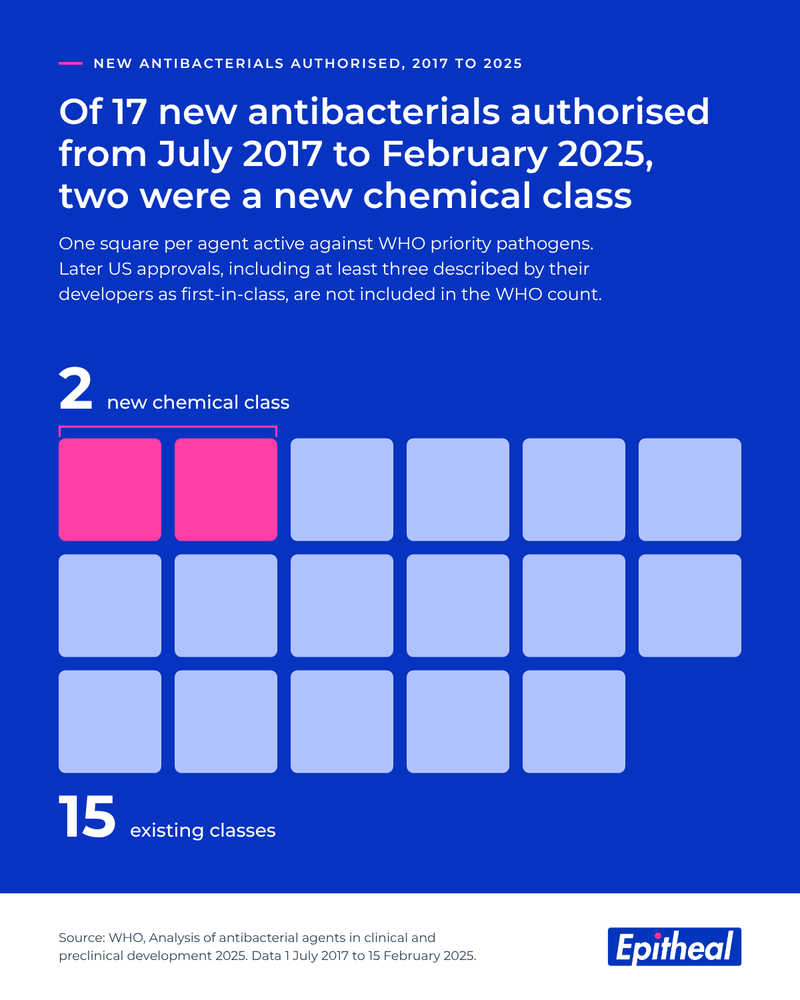
The WHO counts an antibiotic as innovative if there is no known cross-resistance with existing drugs, if it acts on a new target, if it works by a new mode of action, or if it belongs to a new class [1]. One is enough. The test applies to traditional antibiotics, meaning small molecules that act directly on bacteria. Plenty of useful medicines fail it; many recent approvals improve on an existing class in ways that matter to the patients who receive them, and bring that class's resistance problems along.
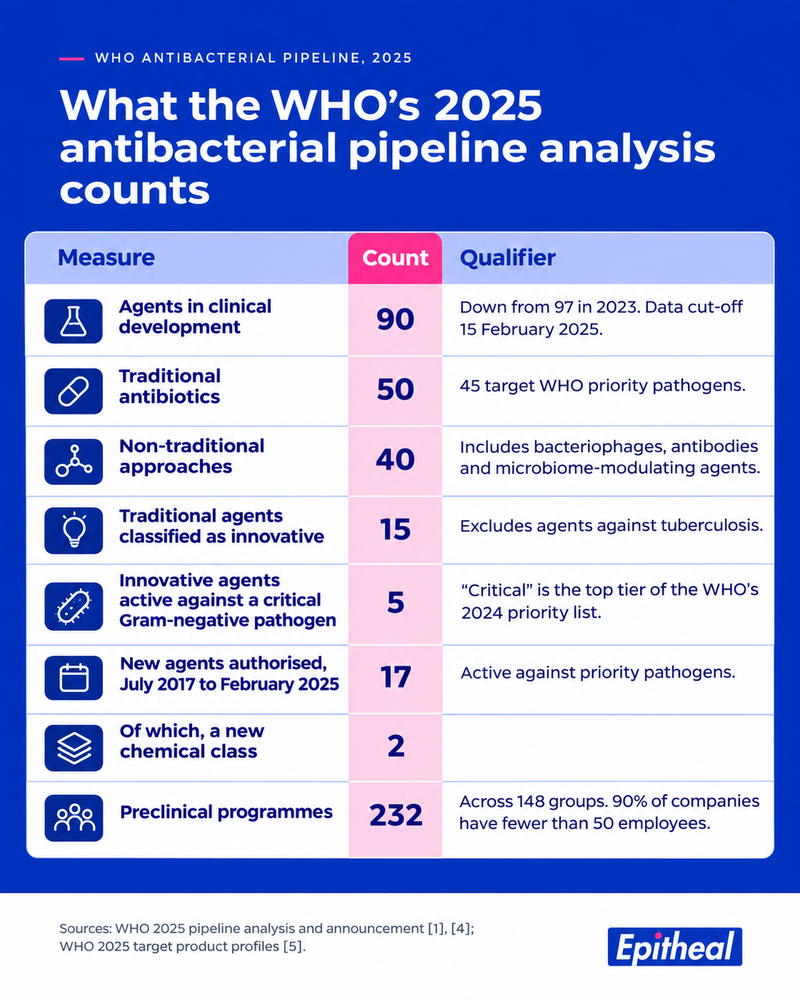
The 2025 review, which took in everything in development up to 15 February 2025, found 90 agents in clinical trials, seven fewer than in 2023 [4]. Fifty were traditional antibiotics. The other 40 were what the WHO calls non-traditional approaches, among them bacteriophages, antibodies and agents that act on the microbiome [4]. Of the 50 traditional drugs, 45 target priority pathogens, and 18 of those are aimed at drug-resistant tuberculosis [4]. In its own summary, the WHO described "a dual crisis: scarcity and lack of innovation" [4].
Table 1. What the WHO's 2025 antibacterial pipeline analysis counts
Five of the 15 reach the most dangerous bacteria
The bleakest number in the announcement is that only five agents are effective against at least one bacterium in the WHO's "critical" category, the top tier of its priority list [4]. What the five are a share of, the announcement leaves open. The answer is in the WHO's 2025 target product profiles. Fifteen traditional agents, leaving tuberculosis drugs aside, meet the innovation criteria, and five of those 15 are active against critical Gram-negative bacteria [5].
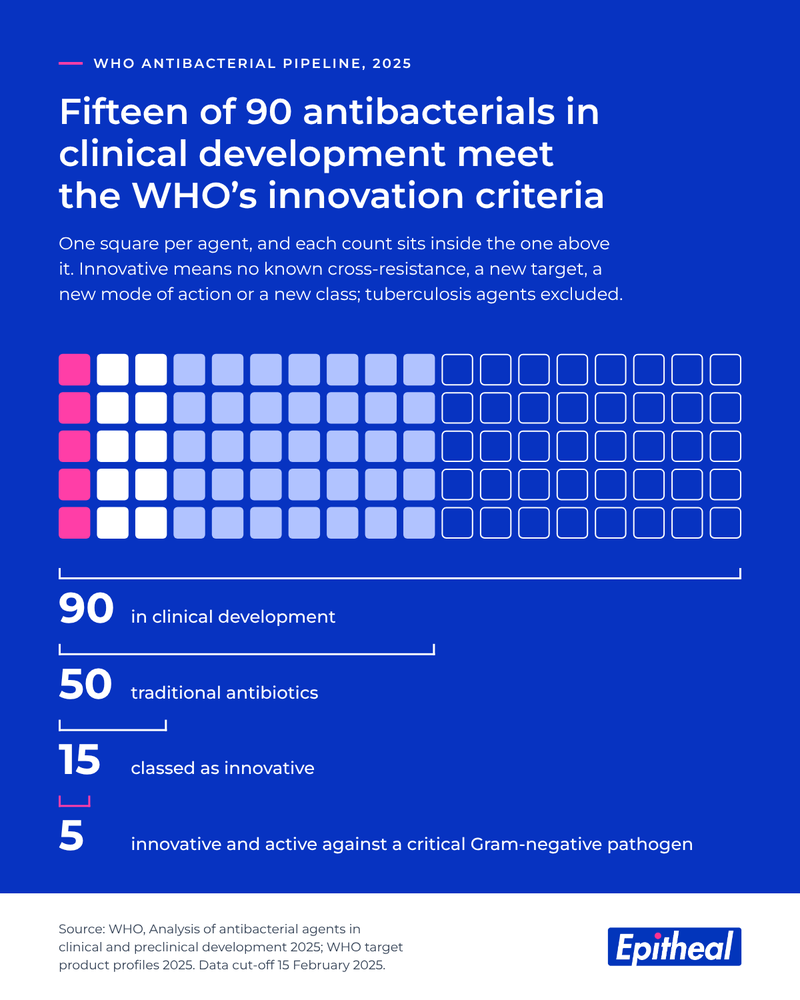
At least one news summary turned this into five of the 90, which is a different and bleaker claim. It is also wrong. Plenty of agents that fail the innovation test still act against critical pathogens; they simply are not new. The WHO adds a caution of its own about the 15, which is that for ten of them the data are not yet good enough to rule out cross-resistance [4].
When did a new class of antibiotics last reach patients?
Since March 2025, the US Food and Drug Administration has approved at least three antibiotics that their developers describe as first-in-class. Gepotidacin came first. The FDA approved it in March 2025 for uncomplicated urinary tract infection and added uncomplicated urogenital gonorrhoea to its licence on 11 December; GSK calls it first-in-class [6]. The next day the FDA approved zoliflodacin for gonorrhoea, a single oral dose from a new class, the spiropyrimidinetriones [7]. On 30 May 2026 it approved Wockhardt's Zaynich, a combination of cefepime and zidebactam for complicated urinary tract infection, which the company describes as a first-in-class beta-lactam enhancer [17].
That sits awkwardly with a line still repeated in many explainers, that no new class of antibiotic discovered since 1987 has reached the market. None of the three appears in the WHO's 2025 figures, which stop in February 2025. Whether each counts as a new class on the WHO's own criteria is for its next review to say. The preclinical pipeline is far from empty either, with 232 programmes in 148 groups [4].
Most of the early work is done by companies with fewer than 50 staff
Most of the companies behind that work are small. Nine in ten of those in the preclinical pipeline employ fewer than 50 people, which the WHO reads as a sign of how fragile antibacterial research has become [4].
Zoliflodacin's route to market shows the fragility, and one way round it. AstraZeneca first identified the compound. A phase 2 trial was sponsored by the US National Institute of Allergy and Infectious Diseases, and the phase 3 trial, with 930 participants at 16 sites in five countries, was sponsored and run by the Global Antibiotic Research and Development Partnership (GARDP), a not-for-profit body [7]. GARDP lists funding for the work from the governments of Germany, the United Kingdom, Japan, the Netherlands, Switzerland and Luxembourg, from the European Commission's Health Emergency Preparedness and Response Authority, and from others [7]. In the US, the marketing authorisation is held by a commercial company, Innoviva Specialty Therapeutics. GARDP's executive director, Dr Manica Balasegaram, said the drug "shows that a different public-private partnership approach to antibiotic development is possible" [7].
GARDP is developing zoliflodacin for gonorrhoea and nothing else, so that it is used only for the infection it was made for and keeps working longer [7]. Stewardship was built in before a single prescription had been written. Commercially, that is an odd thing to do to a new product, since the better it is protected, the less of it will ever be sold.
Why does a useful new antibiotic struggle to pay for itself?
Good stewardship keeps the sales of a new antibiotic small, and sales are what normally pay for its development. NHS England's guidance on its subscription model notes that investment in new antimicrobials is widely seen as "commercially unattractive", and accepts that the need for clinical stewardship undermines the normal business model [8]. Development is expensive. A medicine that prescribers are asked to hold in reserve earns little.
The UK and the EU have taken different routes round the problem.
Table 2. Two approaches to paying for new antimicrobials
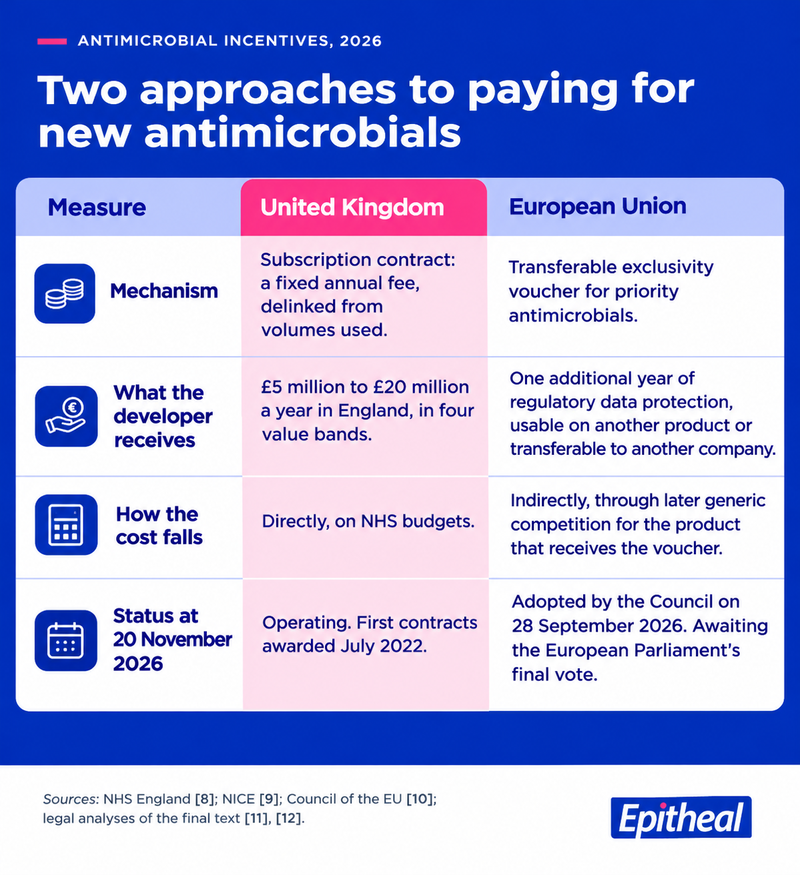
NHS England pays a fixed annual fee for selected antimicrobials, based mainly on an assessment of their value rather than on how much is used, and says it was the first health system in the world to do so [8]. There are four bands. The top band, for products the guidance judges to offer exceptional value, is worth £20 million a year in England, and the lowest £5 million [8]. Contracts can run to 15 years but not past the end of a product's exclusivity, and suppliers may not link their sales representatives' pay to antimicrobial sales [8]. NICE describes the first subscription-style contracts, awarded in July 2022, as a global first [9].
Brussels has gone another way. The pharmaceutical package adopted by the Council of the EU on 28 September 2026 includes a transferable exclusivity voucher for companies that develop priority antimicrobials [10]. Lawyers who have analysed the final text describe it as one extra year of regulatory data protection, which the holder can use on a different product or sell to another company [11]. No health system pays the developer directly. Instead the cost turns up later, as a year's delay before generic competition on whichever product ends up carrying the voucher. None of this is law yet. The package still needs the European Parliament's final vote and publication in the Official Journal, and enters into force twenty days after publication [12].
On the island of Ireland, the two systems will sit side by side. NHS England's 2024 tender for subscription contracts covered Northern Ireland along with England, Scotland and Wales, with contracts due to start on 1 April 2026 [13]. South of the border, the Republic would come under the EU voucher if and when it takes effect. Neither scheme covers the established antibiotics dispensed every day; both are built for medicines newly on the market.
Much of what is missing is a formulation or a test
Parts of the WHO's list of gaps could have been written by a pharmacist. It names paediatric formulations, oral treatments that can be used outside hospital, and combinations with non-traditional agents [4]. An antibiotic that exists only as a drip does little for an infection treated at home, and one with no formulation a child can take does little for a child.
Testing is the other half. In the WHO's 2026 country self-assessment survey, answered by 183 countries, only 36% reported a national reference laboratory equipped to test the bacteria and fungi the WHO has selected, against a target of 80% of countries by 2030 [14]. Only 63% reported guidelines on appropriate antimicrobial use. Most countries now have a national action plan, 173 by the survey's count, but only 22% report both the funding and full implementation [14]. When the figures came out on 16 November, the WHO Director-General's verdict was that "an unfulfilled plan helps no one" [14]. The diagnostics review published alongside the 2025 pipeline analysis adds two specific gaps: poor access to tests that tell bacterial from viral infection, and too few simple point-of-care tools for primary care [4].
Those gaps were on the programme in Düsseldorf the same week. MEDICA 2026, which ran from 16 to 19 November, made point-of-care diagnostics one of its headline topics, and its start-up programme listed a session on identifying pathogens quickly and guiding antibiotic choice at the point of care [15]. On 17 November the fair held its first Infection Control Forum, on preventing healthcare-associated infections, hand hygiene and compliance, and data-driven hygiene management [16]. A trade fair's programme shows where industry expects buyers to look. It says nothing about which tools work, or whether they will reach the primary care clinics in low-resource countries where, according to the WHO, most patients first present and the diagnostic gaps are widest [4].
This year's campaign theme starts with prevention, and the WHO's statement on the survey ties prevention and testing together. Each infection prevented, it says, means fewer antimicrobials are needed, and testing means treatment goes only to patients who need it [14]. Work of that kind never shows up in a pipeline count, though it largely decides how long the antibiotics already on the shelf keep working.
Anything sold as new should face the same test
Anyone assessing a medicine, test or service described as innovative in this area can borrow the WHO's approach, which comes down to two questions. The first is whether it meets any of the four tests at all: no known cross-resistance, a new target, a new mechanism or a new class. The second is what evidence supports it, against what comparator, and in which patients. For non-traditional approaches, which sit outside the WHO's criteria for traditional antibiotics, the second question is close to the whole assessment.
Stewardship belongs in that assessment from the start. Zoliflodacin's single-indication design and the sales-pay condition in the UK contracts both treat protecting a drug's effectiveness as part of the product, and buyers can reasonably expect the same of anything else that claims to be new.
The European Parliament's final vote, still pending as this was written, will decide whether the EU voucher becomes law. As for the WHO, its next pipeline review will show whether the first-in-class approvals since 2025 are the start of something or a short run. Until then, the arithmetic from the start of this piece stands. Seventeen new antibiotics were authorised in seven and a half years and two came from a new class, while much of the work of keeping them effective goes on outside the laboratory, on the ward and at [the pharmacy counter](REPLACE: Pharmacist's Role in Wound Care hub URL).
Epitheal is a pharmacist-founded skin and wound recovery company based in Cornamona, Co. Galway. Community pharmacy is our first channel. We write about the evidence environment in wound care because it is the one our products have to stand up in.
4. References
[1] World Health Organization. Analysis of antibacterial agents in clinical and preclinical development: overview and analysis 2025. Geneva: WHO; 2025. ISBN 978-92-4-011309-1. https://www.who.int/publications/i/item/9789240113091.
[2] World Health Organization. World AMR Awareness Week 2026 (campaign page). https://www.who.int/campaigns/world-amr-awareness-week/world-amr-awareness-week-2026.
[3] World Health Organization. Antimicrobial resistance. Fact sheet, 16 July 2026. https://www.who.int/news-room/fact-sheets/detail/antimicrobial-resistance.
[4] World Health Organization. WHO releases new reports on new tests and treatments in development for bacterial infections. Departmental update, 2 October 2025. https://www.who.int/news/item/02-10-2025-who-releases-new-reports-on-new-tests-and-treatments-in-development-for-bacterial-infections.
[5] World Health Organization. Target product profiles for new antibacterial agents. Geneva: WHO; 2025. https://iris.who.int/server/api/core/bitstreams/aba1b95b-1183-4c27-8603-d9c306a0d57d/content.
[6] GSK plc. Blujepa (gepotidacin) approved by US FDA as oral option for treatment of uncomplicated urogenital gonorrhoea (uGC). Press release, 11 December 2025. https://www.gsk.com/en-gb/media/press-releases/blujepa-gepotidacin-approved-by-us-fda-as-oral-option-for-treatment-of-uncomplicated-urogenital-gonorrhoea-ugc/.
[7] Global Antibiotic Research & Development Partnership. NUZOLVENCE (zoliflodacin), first-in-class oral antibiotic for gonorrhoea, receives U.S. FDA approval. Press release, 12 December 2025. https://gardp.org/nuzolvence-zoliflodacin-first-in-class-oral-antibiotic-for-gonorrhoea-receives-u-s-fda-approval/.
[8] NHS England. Antimicrobial products subscription model: guidance on commercial arrangements. Publication reference PRN01167. https://www.england.nhs.uk/medicines-2/antimicrobial-products-subscription-model/.
[9] National Institute for Health and Care Excellence. Models for the evaluation and purchase of antimicrobials. https://www.nice.org.uk/about/what-we-do/life-sciences/nice-advice-service/models-for-the-evaluation-and-purchase-of-antimicrobials.
[10] European Commission. Communication to the European Parliament pursuant to Article 294(6) TFEU concerning the position of the Council on the adoption of a directive on the Union code relating to medicinal products for human use. COM(2026) 526 final, transmitted as Council document ST 13769/26, 29 September 2026. https://data.consilium.europa.eu/doc/document/ST-13769-2026-INIT/en/pdf.
[11] Taylor Wessing. The 2026 Pharma Package: a new regulatory framework for medicinal products in the EU. 2026. https://www.taylorwessing.com/de/international-life-sciences-newsletter/life-sciences-legal-lens-vol-1/the-2026-pharma-package-a-new-regulatory-framework-for-medicinal-products-in-the-eu.
[12] CMS. EU Pharmaceutical Package: what the Council's revised texts mean for companies. 2 October 2026. https://cms.law/en/nor/legal-updates/eu-pharmaceutical-package-what-the-council-s-revised-texts-mean-for-companies.
[13] NHS England. Contract notice: provision of antimicrobial products via a subscription model contract in England, Scotland, Wales and Northern Ireland. Find a Tender notice 025397-2024. https://www.find-tender.service.gov.uk/Notice/025397-2024/PDF.
[14] World Health Organization. More countries have antimicrobial resistance plans but patients still lack testing and treatment. News release, 16 November 2026. https://www.who.int/news/item/16-11-2026-more-countries-have-antimicrobial-resistance-plans-but-patients-still-lack-testing-and-treatment.
[15] Messe Düsseldorf GmbH. Point-of-care & diagnostics (MEDICA 2026 hot topic page, including programme highlights). https://www.medica-tradefair.com/en/Visit/Hot_Topics/point-of-care-diagnostics.
[16] Messe Düsseldorf GmbH. Safe care begins with hygiene: debut for new forum. MEDICA Newsflash, 15 October 2026. https://www.medica-tradefair.com/en/Media_News/News/MEDICA_Newsflash/Safe_care_begins_with_hygiene_debut_for_new_forum.
[17] Wockhardt Ltd. Wockhardt receives U.S. FDA approval for ZAYNICH (cefepime and zidebactam), a novel intravenous antibiotic for the treatment of adult patients with complicated urinary tract infection including pyelonephritis. Press release, 30 May 2026, as distributed via BioSpace: https://www.biospace.com/press-releases/wockhardt-receives-u-s-fda-approval-for-zaynich-cefepime-and-zidebactam-a-novel-intravenous-antibiotic-for-the-treatment-of-adult-patients-with-complicated-urinary-tract-infection-including-pyelonephritis.